Applications / Rapid Optics Fab
Rapid Optics Fab
Custom diffractive optics, made in days
Rapid Optics Fab is 123D’s fabrication service for diffractive optical elements: phase masks, diffractive and Fresnel lenses, vortex plates and other custom elements. It is built on near-index matching, a patented method developed at the Technion, which lets a commercial 3D printer do work that otherwise needs cleanroom lithography.
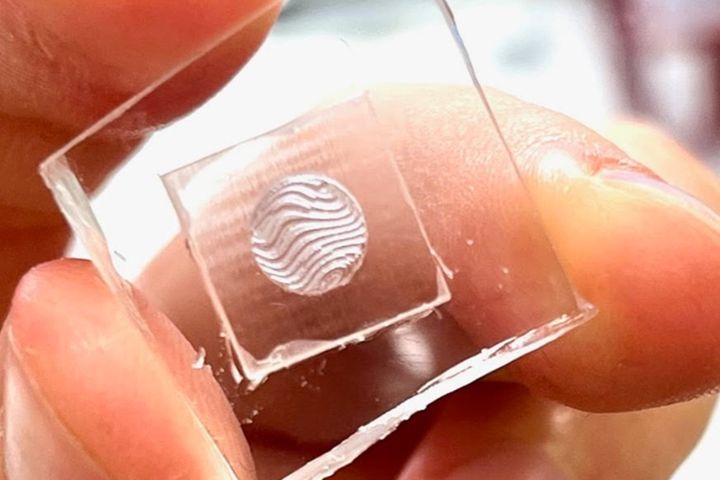
A phase mask made by near-index matching
- Turnaround
- Two to three days per element in the published process
- Relief
- Hundreds of micrometers deep, where a conventional element needs about one
- Tools
- A commercial 3D printer and casting. No cleanroom
Why diffractive optics are hard to make
A diffractive optical element shapes light by delaying it. A relief of height h delays the wave in proportion to h × Δn, where Δn is the difference in refractive index between the element and what surrounds it. In air Δn is about 0.5, so a full wave of delay takes about a micrometer of relief, and the surface has to be accurate to a small fraction of that.
That precision usually means photolithography or a comparable process, with its masks, cleanroom, lead time and cost. Every change of design starts the cycle again, which makes iteration slow and custom elements expensive.
Near-index matching
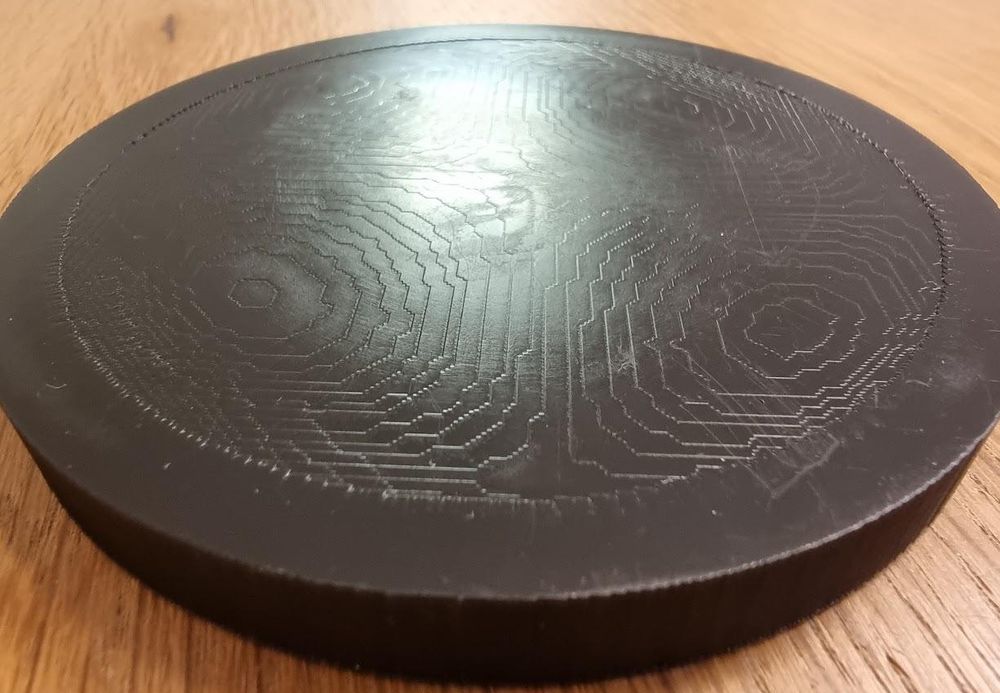
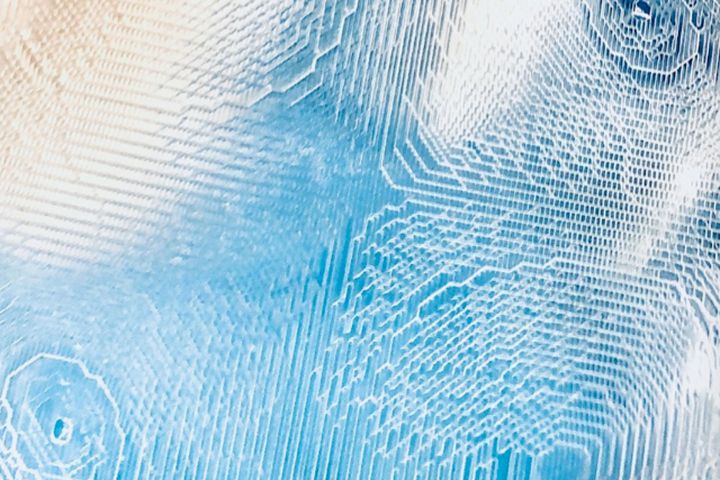
Near-index matching puts the relief between two transparent materials whose refractive indices are almost equal. In the published work Δn was between 0.001 and 0.007, which stretches the required relief by two to three orders of magnitude.1 A step that was a micrometer deep becomes hundreds of micrometers deep, and the tolerance on it grows in the same proportion, into the range of a commercial 3D printer (Fig. 1).
The method was first shown with the relief immersed in an index-matched liquid,2 and then as a fully solid element.1
How an element is made
- Print the moldThe inverse of the relief is 3D printed at a resolution of tens of micrometers.
- CastThe first material is poured over the mold and cured.
- Release and fillThe cast is released, and a second material with a nearly matched index is cured on its relief.
- Finished elementThe relief is now buried inside a solid, flat element that shapes the light passing through it.
In the published process an element takes two to three days, most of it curing time.1 A newer route forms the relief in a single grayscale exposure on a consumer-grade printer, in under ten minutes.3
What we make
- Phase masks for depth-encoding and extended-focus imaging.
- Diffractive and Fresnel lenses and microlens arrays. A published 3 × 3 array of 2 mm lenses focused to a spot of 340 µm, against a diffraction limit of about 320 µm.1
- Vortex (spiral) phase plates, including high orders. One was used in MINSTED nanoscopy, where the dark center of the beam stayed below 1% of the brightness of its ring.1
- Wavelength-selective masks for multicolor and spectral imaging.1
- Aberration-correcting plates.
- Large elements, up to the aperture of a telescope (Fig. 2a).
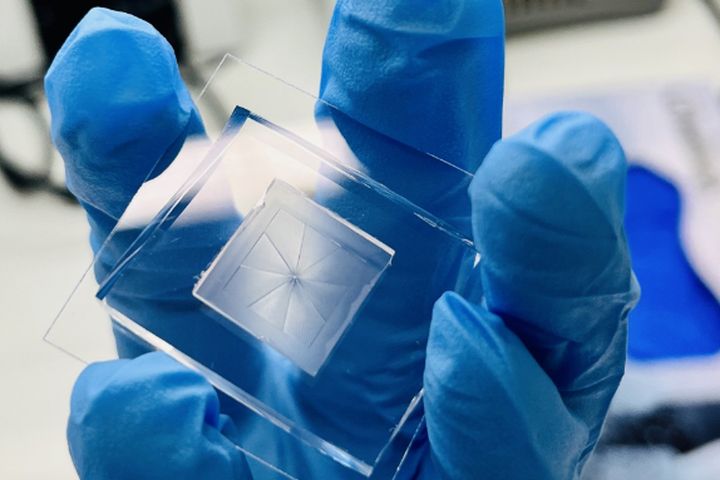
Vortex plate
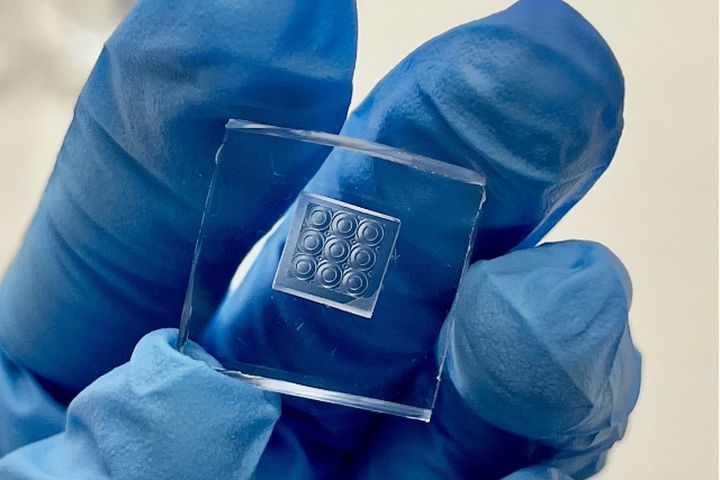
Microlens array
What to know
- An element is designed for a wavelength band, and the two materials are chosen for closely matching dispersion.
- The published material pairs are silicone-based and may not suit high-power lasers.1
- Operating temperature is part of the specification, because the design rests on a small index difference between two materials.
- The process is for prototypes, custom parts and small series. It is not a mass-production process today.
Ask for an element
Rapid Optics Fab is for optical designers and instrument makers who need a custom element quickly, who want to try several designs before committing to lithography, or who need an element too large for it.
Tell us the wavelength, the aperture and the phase profile or function you need. We will tell you whether we can make it, and how soon.
Rapid Optics Fab is part of 123D. Its optics are at work in microscopy and inspection, flow imaging and monocular depth.
References
- R. Orange Kedem et al., “Near index matching enables solid diffractive optical element fabrication via additive manufacturing,” Light: Science & Applications 12, 222 (2023).
- R. Orange-Kedem et al., “3D printable diffractive optical elements by liquid immersion,” Nature Communications 12, 3067 (2021).
- L. Leites et al., “Fabrication of customized diffractive optics in under 10 minutes via single-shot grayscale projection on a consumer-grade DLP system,” ACS Photonics (2026).